Minimum isolated stroke
The rule was checked at final output size rather than on-screen zoom. Fine hatching below the threshold was merged or removed so it would not fill in unpredictably on cotton.
A close look at the decisions that turn an apparel idea into a controlled production file: scale, resolution, construction, garment colour and release checks.
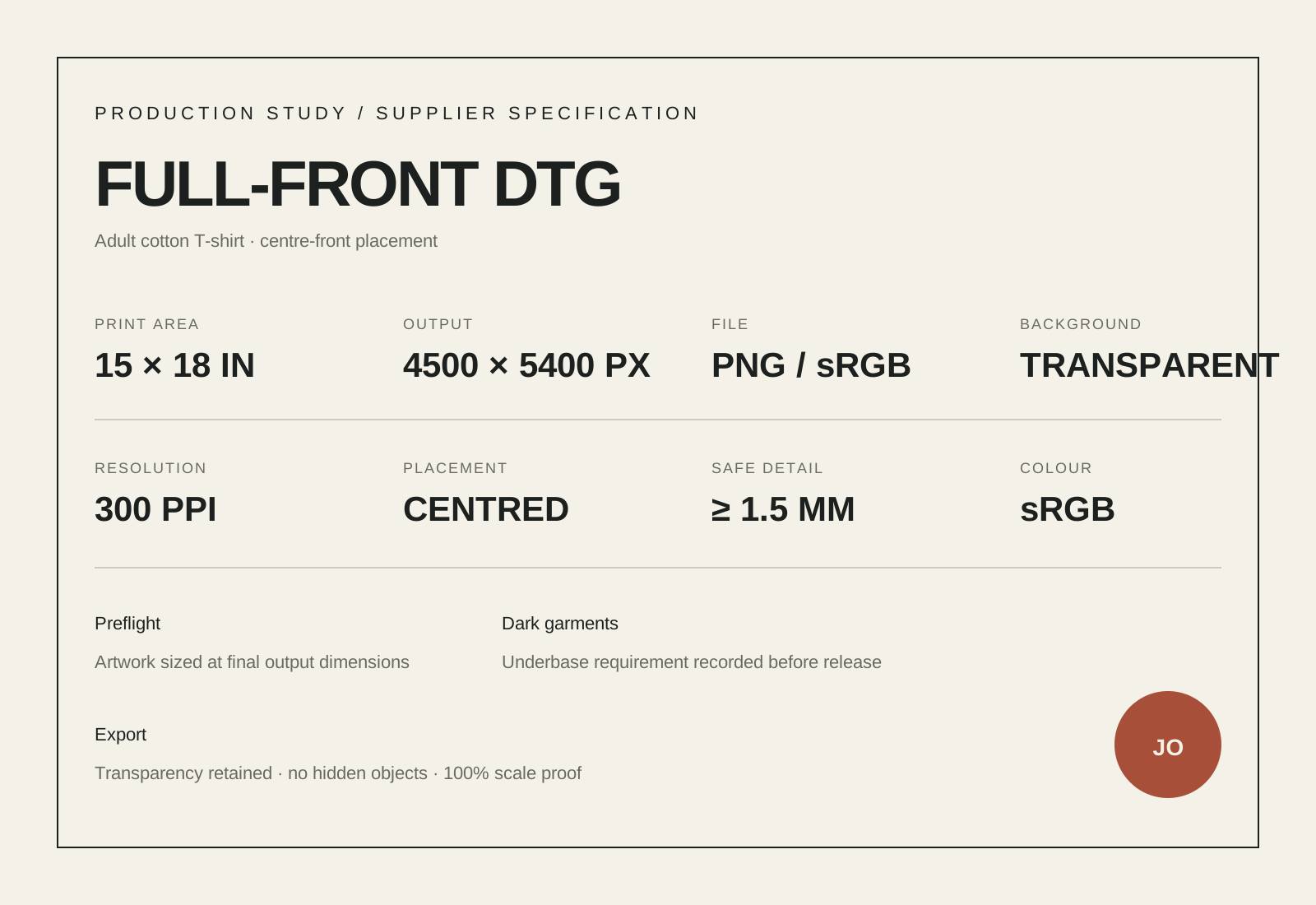
The design had to retain its character on cotton while meeting a full-front DTG specification and remaining readable across garment sizes and dark-fabric ink conditions.
The artwork was constructed on the supplier’s stated 15 × 18 inch print area, kept vector through development, and released as a transparent 4500 × 5400 pixel PNG at 300 ppi. A conservative 1.5 mm minimum isolated stroke was applied at final size.
The resulting release package separates the editable master, light- and dark-garment treatments, placement proof and production export so each stage can be checked without rebuilding the artwork.
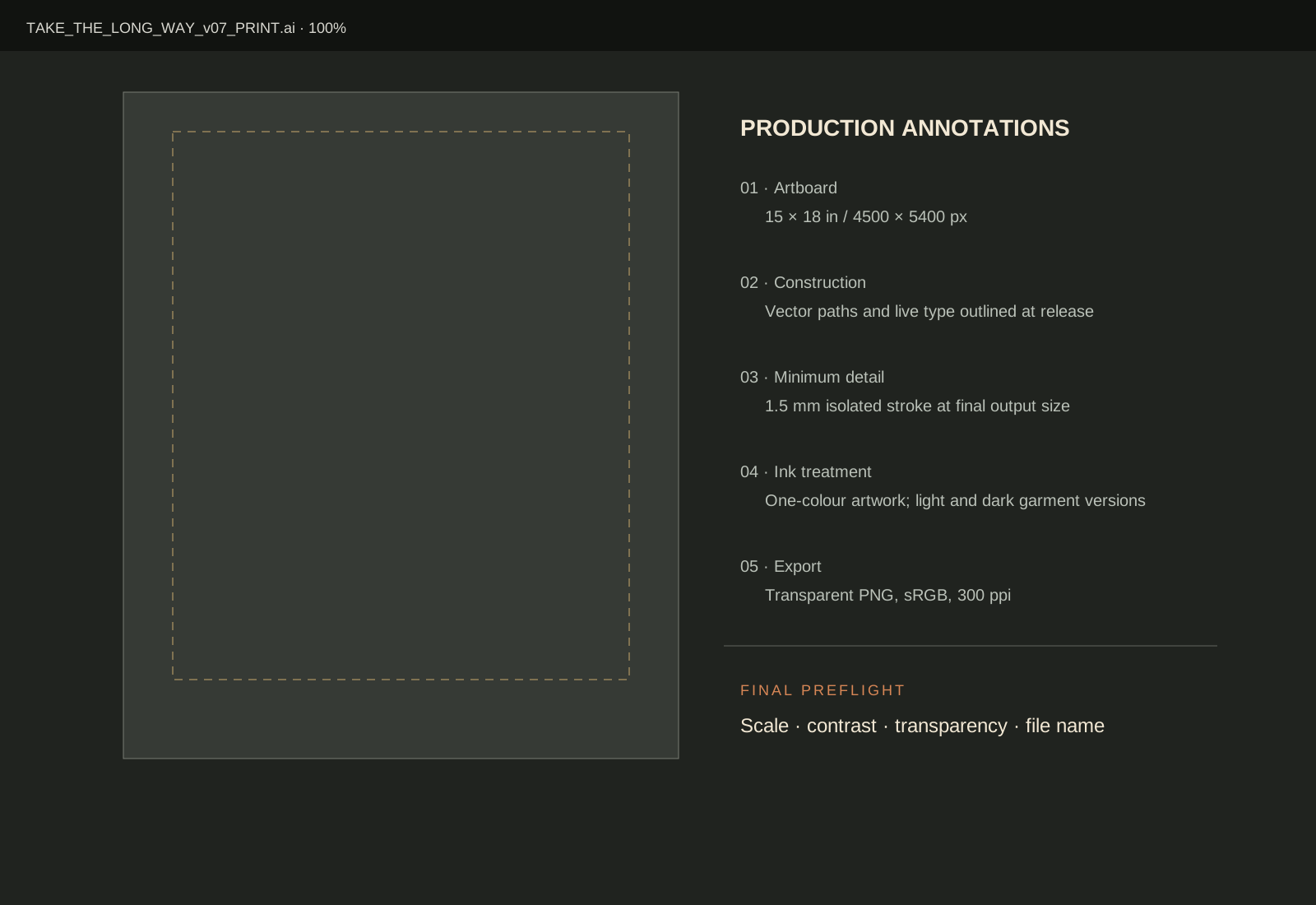
The rule was checked at final output size rather than on-screen zoom. Fine hatching below the threshold was merged or removed so it would not fill in unpredictably on cotton.
Dark garments use a light artwork file with the underbase requirement recorded in the handover. Light garments use the inverse dark-ink treatment rather than the same file dropped on unchanged.
Colour was judged against a printed proof and fabric colour, not the monitor alone. The production file stays in sRGB while the release note records the intended garment and ink treatment.

The first proof exposed a weak point: small distressed gaps that looked intentional on screen became visual noise at garment scale. I removed sub-threshold speckling, added a 100% scale proof to every release, and introduced a preflight check covering minimum detail, transparency, garment treatment and file naming.
Clear hierarchy
Consistent application
Purposeful detail